




Insights · Joint replacement
Knee replacement
recovery, week
by week
What actually happens after a knee replacement, from the first assisted steps on day one to walking without thinking about it months later.
The operation takes about an hour. The result is decided over the following twelve weeks.
Reviewed by Dr. Nisarg Trivedi, M.S. Orthopaedics · Vishwas Orthopaedic Hospital, Bharuch
Key points
- Assisted walking usually begins on the day of surgery or the next day
- Most patients manage at home with support within three to five days
- Daily activities typically return over six to twelve weeks
- Swelling and warmth can persist for several months and are normal
- Recovery depends heavily on how consistently exercises are done
Patients considering knee replacement rarely ask about the operation itself. They ask how long before they can climb the stairs at home, sit on the floor, drive, travel, or return to a shop counter. Those are the right questions, because the surgery is a single hour and the recovery is a season.
The timeline below reflects what a straightforward total knee replacement usually looks like. Individual recovery varies with age, general health, how stiff the knee was before surgery, and whether other joints are also affected.
Weekby week.
Day 0 to day 2
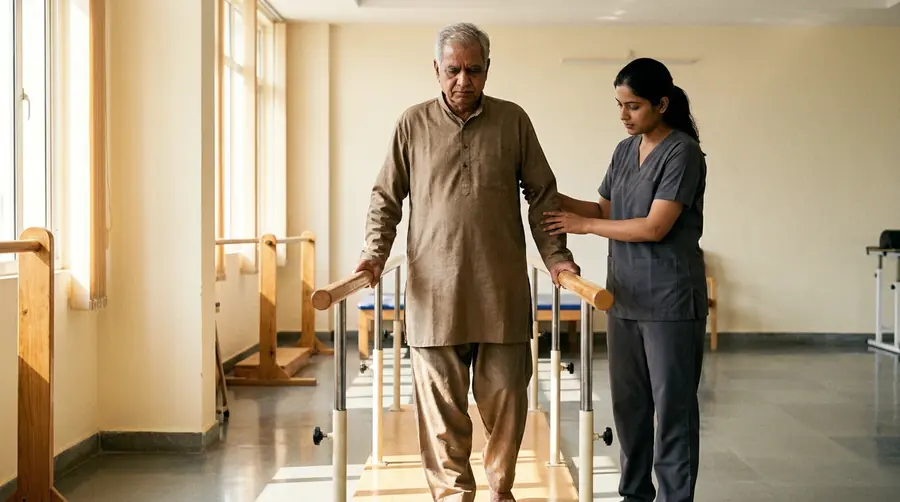
You are encouraged out of bed early, usually the same day, standing and taking a few steps with a walker and supervision. Pain relief is planned rather than reactive. Ice, elevation and gentle ankle movement begin immediately to control swelling and reduce clot risk.
Day 3 to week 2
Most patients go home within three to five days, walking short distances with a walker or stick. The goals are simple and measurable: straighten the knee fully, bend it a little further each day, and walk a little more often rather than a lot at once. Stitches or clips are reviewed at around two weeks. Desk-type work from home is often possible in this window.
Week 2 to week 6
Support is reduced as confidence returns, often from walker to stick and then to nothing indoors. Bending typically progresses past ninety degrees. Stairs are practised deliberately, leading with the operated leg going up and the other leg going down. Many patients stop needing regular pain medication in this period, and driving becomes possible once the leg can control the pedals without hesitation.
Week 6 to week 12
This is where the outcome is decided. Strength work becomes the priority rather than movement alone. Walking distance extends, household activity returns to normal, and travel becomes comfortable. Swelling reduces but is still noticeable at the end of the day.
Month 3 to month 12
The knee continues to improve gradually. Warmth, mild swelling after a long day and occasional clicking are common and expected. Low-impact activity such as walking, cycling and swimming is encouraged. Running and contact sport are generally discouraged, because they shorten implant life.
What changesthe outcome.

Before surgery
- Strengthening the quadriceps beforehand measurably shortens recovery
- Blood sugar, blood pressure and dental infection are settled in advance
- Home is prepared: a firm chair, a handrail where possible, clear floors
- Weight reduction, where advised, reduces load on the new joint for decades
After surgery
- Full straightening matters more than deep bending in the first two weeks
- Frequent short walks beat occasional long ones
- Ice and elevation are treatment, not comfort measures
- Exercises are done daily, including on the days they feel unnecessary
What to report immediately
- Fever, or wound discharge, redness or increasing warmth
- Calf pain, or sudden breathlessness
- Pain that increases sharply after a period of improvement
- Inability to bear weight after a fall
These are typical patterns rather than guarantees, and no operation is without risk. Your surgeon will discuss the specific risks that apply to you.
Frequentquestions.
Is knee replacement very painful?
It is uncomfortable rather than unbearable, and pain is managed with planned medication, nerve blocks where appropriate, ice and early movement. Most patients find pain reduces markedly after the first two weeks.
Will I be able to sit cross-legged or on the floor?
Many patients regain enough bend to sit cross-legged with practice, but it cannot be promised. Kneeling often remains uncomfortable even when the knee is otherwise excellent.
How long does a knee replacement last?
Modern implants commonly function well beyond a decade, and frequently much longer. Longevity depends on age, weight, activity level and how accurately the implant is aligned.
When can I travel or return to work?
Short local travel is usually comfortable by four to six weeks, and desk work often earlier. Work that involves standing all day, squatting or heavy lifting takes longer and is planned individually.
Related care
Considering knee replacement?
Bring your recent X-rays if you have them. A consultation will tell you whether replacement is needed now, later, or not at all.