






Insights · Knee
Knee pain
on stairs
Going down usually hurts more than going up. That single detail tells an orthopaedic surgeon a great deal about what is happening inside your knee.
Stairs are the most honest test in orthopaedics. They load the knee in a way flat walking never does.
Reviewed by Dr. Nisarg Trivedi, M.S. Orthopaedics · Vishwas Orthopaedic Hospital, Bharuch
Key points
- Climbing loads the knee with roughly three to four times body weight
- Pain going down more often involves the kneecap surface or cartilage
- Pain going up more often reflects strength loss or joint space narrowing
- Swelling that returns after stairs deserves assessment
- Most stair pain improves without surgery when the cause is identified early
Almost every patient who walks into an orthopaedic clinic with knee pain mentions stairs. It is rarely the first symptom, but it is usually the one that finally prompts the appointment, because stairs cannot be avoided at home, at work or at a temple.
There is a reason stairs hurt before flat ground does. Walking on level ground loads the knee with a little over your body weight. Climbing raises that to roughly three to four times body weight, and descending is harder still, because the muscles must absorb the load while lengthening. A knee that copes quietly with a morning walk can protest on the second flight of stairs.
The useful part is that the direction of the pain narrows the diagnosis considerably before any scan is ordered.
Why stairsexpose it.
Pain going down
Descending compresses the kneecap against the front of the thigh bone while the quadriceps works to control the fall. Pain that is worse going down, worse after sitting for a long film or a long meeting, and felt at the front of the knee usually involves the kneecap surface, the cartilage behind it, or early wear in the front compartment of the joint.
- Front-of-knee pain, sometimes described as being behind the kneecap
- Discomfort after long sitting, easing after a few steps
- A grinding or gritty sensation with squatting
- Ache after a long day rather than a sharp catch
Pain going up
Climbing demands strength and a joint surface that can tolerate compression through a bent knee. Pain that is worse going up, felt on the inner side, and accompanied by morning stiffness more often reflects loss of joint space, weak quadriceps and hip control, or a meniscus that has degenerated with time.
- Inner-side pain with stiffness in the first minutes of the day
- A knee that feels weak or unreliable on the first step
- Reduced comfortable walking distance over months
- Occasional swelling after activity
The part patients rarely expect
A significant number of stair-related knee complaints begin above the knee. Weak hip abductors allow the thigh to drop inwards on each step, which changes how the kneecap tracks. The knee hurts, but the hip is the reason. This is why an examination that stops at the knee often misses the answer, and why strengthening programmes that ignore the hip tend to disappoint.
Signs that should not wait
- The knee gives way, or you have stopped trusting it on stairs
- Swelling appears within hours of an injury
- The knee locks, catches, or cannot be straightened fully
- Pain wakes you at night, or is present at rest
- You have started avoiding stairs altogether
What usuallyhelps.
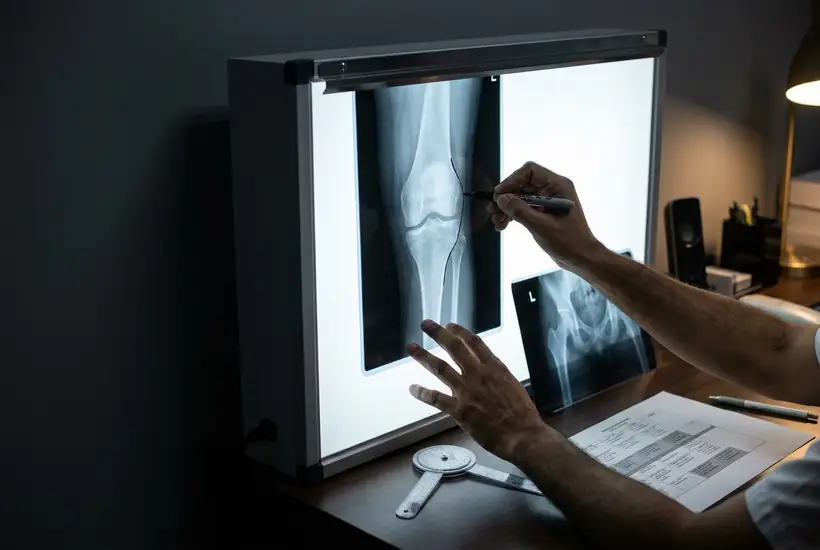
The first consultation is mostly examination. Where the pain sits, how the kneecap tracks, how much the joint bends and straightens, whether the ligaments are stable, and how the hip and calf control the leg all feed into the diagnosis. Imaging is then requested only where it will change the decision.
What imaging actually adds
- Standing X-rays show true joint space and alignment. Lying-down films can make a worn knee look healthier than it is.
- MRI is reserved for suspected soft-tissue injury or when surgery is being considered, not as a first step for every ache.
Non-surgical care, done properly
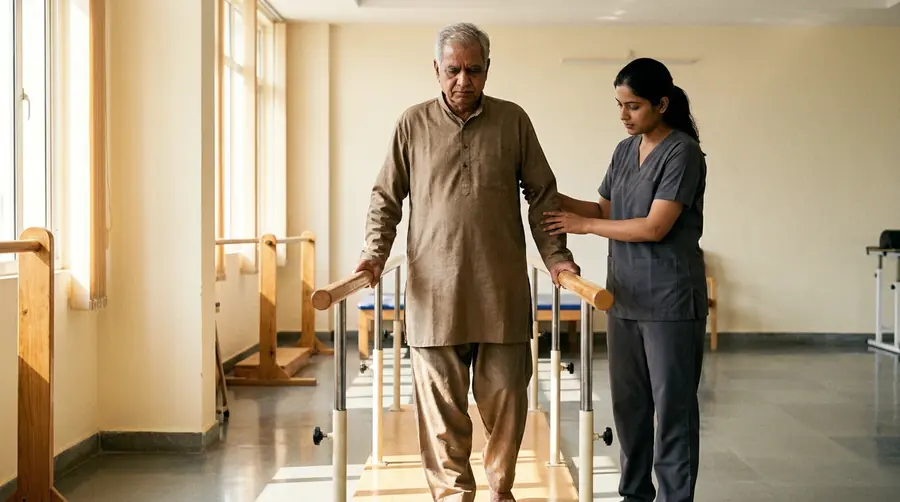
- Targeted quadriceps and hip strengthening, progressed over eight to twelve weeks
- Load modification rather than complete rest, since inactivity weakens the joint further
- Short courses of medication for flare-ups, not for months at a time
- Weight management guidance, because each kilogram is multiplied several times on stairs
- An injection where inflammation clearly dominates the picture
When surgery is discussed
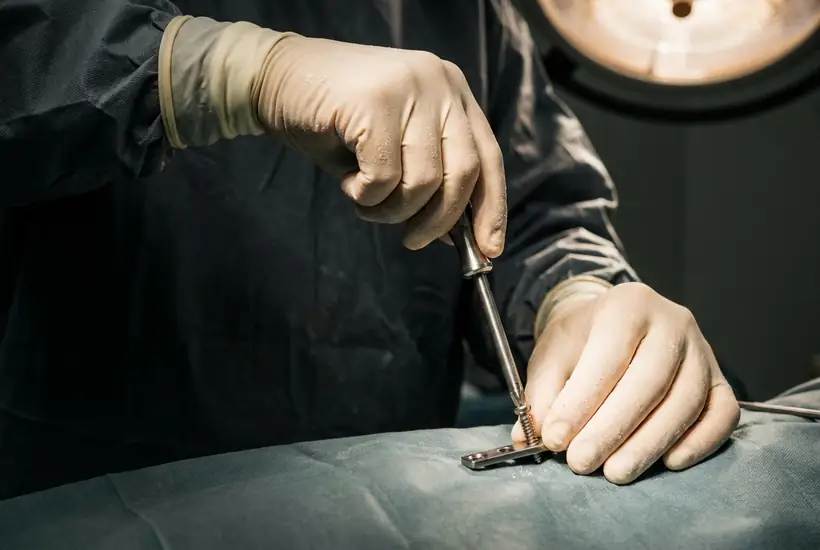
Surgery enters the conversation when a mechanical problem is identified that rehabilitation cannot correct, such as a locking meniscal tear, an unstable ligament, or arthritis that limits sleep and walking despite consistent non-surgical care. Options range from keyhole arthroscopy to partial or total knee replacement, and the choice depends on which part of the joint is worn, your age and how you use the knee.
Timelines and outcomes described here are typical patterns, not promises. Your own assessment decides your plan.
Frequentquestions.
Is knee pain on stairs always arthritis?
No. In younger patients it is more often a kneecap tracking problem, a meniscal tear or a strength deficit. Arthritis becomes more likely with age, prolonged morning stiffness and narrowing visible on weight-bearing X-rays.
Should I stop using stairs completely?
Usually not. Avoiding stairs entirely weakens the muscles that protect the joint. Reducing frequency, leading with the stronger leg and using a handrail while strength is rebuilt is generally better than avoidance.
Do I need an MRI before my first visit?
Rarely. Examination and standing X-rays answer most questions. An MRI ordered before assessment often finds age-related changes that are not the source of the pain, which can lead to unnecessary worry.
How long should I wait before seeing a specialist?
If pain has lasted more than three weeks despite rest and simple medication, if the knee swells or gives way, or if your walking distance is reducing, an assessment is reasonable.
Related care
Knee pain on stairs?
A single consultation with examination and, where needed, weight-bearing X-rays is usually enough to name the problem and set a plan.